
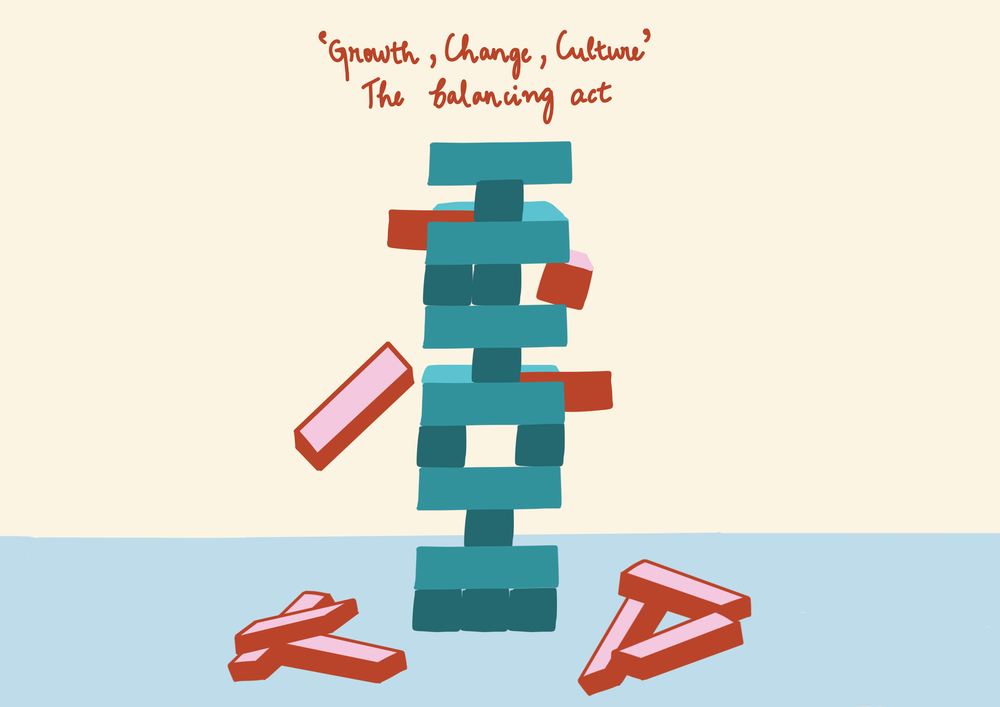
Growth, change, culture: the balancing act
A synthesis of founder, people leader, and employee perspectives on the challenges of growth, change, and trade-offs, and how people technology is evolving alongside.
This report explores how culture, management, and people systems evolve as organisations scale, and where friction emerges along the way. Our research draws on conversations with founders and People/HR leaders across India and Southeast Asia, global and regional employee experience evidence, and market research on People Tech platforms and patterns. Rather than focusing on individual companies or quotes, we surface recurring patterns across these perspectives and triangulate them with published evidence.
In this report
The invisible tax
High-growth organisations, those that have found product-market fit and are in an active scaling phase, pay an invisible tax when culture is unclear, people systems are immature, and managers are unprepared. Leaders feel this tax through slower execution, higher churn, weaker accountability, and rising burnout.
Growth, taxed
Unclear culture, immature systems, and unprepared managers hang off the growth curve as headcount compounds.
Illustrative
Across our research, four truths repeat:
Culture is not what you aspire to. It is what you practice daily.
When organisations scale without defining the cultural core early, culture becomes fragmented and accountability becomes harder. That core reflects how the founding group decides, works, and communicates. Capture it early and practice it deliberately, or growth widens the gap between what a company says and what it does.
What breaks changes by stage.
In early stages, the pain is chaos and overload. In later stages, bureaucracy and culture drift.
Managers are the primary multiplier of experience and performance.
Engagement is most strongly shaped by the immediate manager: 70% of engagement variance is attributable to the manager, yet only 27% of managers globally are engaged (Gallup). Much manager-effectiveness work fails because the learning environment and the practice environment are very different. Unless leadership genuinely cares about high-quality management, capability work stays a side show.
People Tech is evolving fast, but adoption still stalls at the action gap.
Tools are getting better at measuring and automating, but organisations struggle to turn insights into consistent manager behaviour, better decisions, and healthier systems. AI is arriving fastest in talent acquisition and operations, but adoption is still piecemeal.
The cultural core: why this topic matters
After years of work across different workplaces, CultureGram's founding hypothesis is simple: workplaces can be smarter, simpler, kinder, and clearer, but only if leaders take culture seriously as infrastructure, not decoration.
When culture is unclear or overly generic, organisations often compensate with heavier processes, reactive hiring, and additional tools instead of stronger operating rhythms. The cost compounds over time: early on through high attrition and founder bottlenecks, later through slower decision-making, internal politics, and inconsistent leadership behaviour.
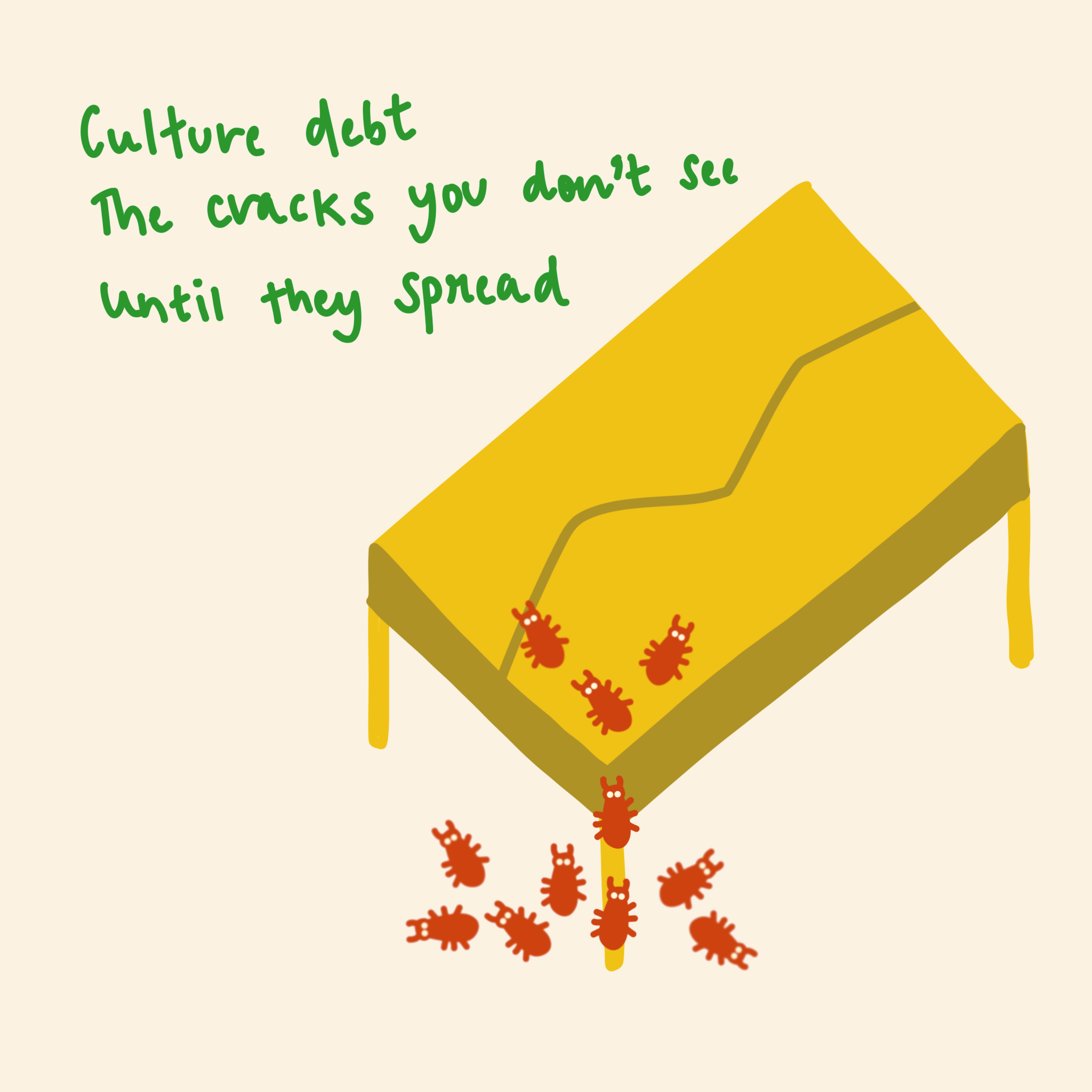
Like product debt, culture debt can be deferred for a while. It becomes significantly harder and more expensive to address as headcount grows.
What founders care about
Founder conversations consistently revealed a clear pattern: people and culture matter deeply to founders through the lens of business outcomes. Rarely do founders talk about culture as an abstract ideal. Instead, they surface it when it starts to affect speed, quality of execution, cost, or morale. Or they end up spending too much of their time on people issues and do not feel they have the right people in the right jobs.
Across discussions, founders were reflective, often candid, and sometimes uneasy. Many recognised that the organisation they were building was no longer the one they personally managed day to day, and that this transition came with both opportunity and risk.
2.1 Outcomes: growth, profitability, and execution
When founders spoke about the next two to three years, the conversation almost always centred on a small set of outcomes: scaling revenue and customer impact, improving operating efficiency, and reducing avoidable churn, particularly in critical roles.
People questions emerged not as standalone concerns, but as constraints on these goals. A recurring tension surfaced across conversations:
"We need to move fast, but the organisation feels harder to steer than it used to."
Founders described feeling this most acutely when decisions that once took hours stretched into weeks, alignment required multiple conversations instead of one, and teams executed in parallel but not always in the same direction.
In early stages, speed came from proximity and trust. As headcount grew, that informal coordination no longer scaled, and founders began to feel the drag.
2.2 Risks: culture drift, leadership stretch, and organisational weight
As organisations scaled, founders became increasingly concerned about what might be lost along the way. Culture drift was rarely described as a sudden break. Instead, it showed up as gradual erosion: behaviours once implicitly understood began to vary by team, new leaders introduced different operating styles, and expectations became uneven across functions or geographies.
This raised deeper questions about leadership capability. Founders wondered whether leaders truly understood how work was meant to happen, whether people were being promoted faster than they were being developed, and whether managers were reinforcing the right ways to work and holding people accountable, or unintentionally undermining them.
A related fear was the organisation becoming heavy, with more approvals, more process, and slower response times.
What breaks changes by stage
The failure mode is not constant. It changes shape as the organisation does.
Illustrative
2.3 The truth problem: knowing what people actually experience
An important theme in founder conversations was the difficulty of knowing what was really happening inside the organisation. As companies grew, founders became increasingly removed from day-to-day employee experience, informal feedback loops weakened, and information arrived filtered through layers of management.
Founders expressed a strong desire for early warning signals before issues escalated, honest feedback that did not soften as it travelled upward, and clarity on whether problems were isolated or systemic.
of candidates consider culture and mission before applying for a role (Glassdoor)
2.4 AI adoption: opportunity, anxiety, and second-order effects
AI adoption surfaced naturally in founder conversations, typically as part of broader discussions about productivity, scale, and decision-making rather than as a standalone strategic priority. Founders were generally optimistic about AI's potential to reduce manual work, increase output, and accelerate internal processes, particularly in areas such as reporting, recruiting workflows, and operational analysis. Several founders described using AI to generate weekly performance summaries or hiring shortlists faster than before, reducing the time senior leaders spent compiling information.
Alongside this optimism, founders expressed concerns about second-order effects. A recurring tension was whether AI would ease pressure on teams or intensify it: several worried that, in already high-intensity environments, it could raise expectations for speed and output without addressing prioritisation, capacity, or clarity of goals. There was also unease about how AI-generated data would be used by managers. While increased visibility was seen as useful, founders questioned whether more metrics would actually lead to better judgment, noting the risk of managers relying too heavily on numbers without sufficient context and narrowing performance conversations rather than improving them.
Founders also raised concerns about how AI adoption might be experienced by employees. They want a more AI-fluent workforce that naturally loves to experiment and learn, and they were keen to incentivise people to use AI productively without blindly relying on it or fearing it. They were clear that this would affect their future hiring needs and organisation design. A few leaders noted that increased automation and monitoring prompted concerns about whether teams would feel supported or scrutinised, especially in organisations where trust and informal feedback loops had already weakened with scale.
What People leaders care about
People leaders sit at a difficult intersection. They are expected to represent the employee experience, enable leaders to perform, and still anchor people decisions in business reality. As organisations scale, this role becomes less about running HR processes and more about holding the organisation together while it changes shape.
Across conversations with senior People leaders in high-growth organisations, a more nuanced picture emerged of what People leaders actually care about, and where they feel stretched. Rather than discrete problems, these concerns form a sequence that mirrors organisational growth.
3.1 Credibility, context, and influence with founders
People leaders want to be credible partners to founders, not merely executors of policy. From conversations, the challenge is less about insight and more about shared language. Many struggled to translate people signals into business and investor terms, to make trade-offs between growth, cost, capability, and risk explicit, and to keep pace with founders who were moving quickly and reprioritising often.
They strongly reinforced that founders bring a deeply intuitive and values-driven view of the people who will succeed in their company. This perspective is often accurate, but rarely articulated.
One of the most important roles of People leaders at this stage is to help founders translate instinct into clear archetypes, and turn those archetypes into hiring, onboarding, and evaluation signals. When this translation does not happen, organisations hire quickly but inconsistently, and later struggle to explain why some people thrive while others fail.
3.2 Preserving the core while the organisation expands
A critical insight was the importance of protecting the core. At the Series B+ and C stage, the first 50 to 100 employees create a disproportionate amount of value. At Razorpay, for example, early senior hires designed the payments platform for scale and regulatory complexity from day one, enabling the company to onboard large enterprises early and later expand into banking and credit: a disproportionate outcome driven by a very small early team.
This group carries cultural memory, execution speed, and informal leadership. While some churn in the extended workforce is inevitable, misalignment or attrition in this core group is far more damaging. People leaders therefore care deeply about identifying this core early, aligning them tightly to the company's evolving direction, and investing disproportionate time and attention in their clarity, growth, and retention. This is rarely explicit work, but when it is neglected, the organisation loses its centre of gravity.
Protect the core
A small early group carries cultural memory, execution speed, and informal leadership.

Illustrative
3.3 Organisation design, payroll discipline, and early cost visibility
Another recurring concern is how easily payroll and people costs can spiral in fast-growing startups. People leaders highlighted that people planning systems are often rudimentary in early stages, over-hiring can happen quickly when growth pressure is high, and payroll costs swell before leaders fully realise the long-term implications.
People leaders therefore care about putting simple org design and people planning systems in place early, building the habit of tracking headcount, payroll, and people cost ratios, and avoiding reactive hiring decisions that are hard to unwind later. This discipline matters not just internally but externally: investors look closely at how well people costs are understood and managed.
Importantly, organisation design at this stage does not need to be perfect, but it does need to be deliberate.
3.4 Goals, performance, and the reality of scale
People leaders consistently describe large-scale goal setting and cascading as one of the hardest operational challenges. In theory, priorities are clear and goals cascade cleanly. In reality, priorities shift frequently, roles change as teams scale, and managing OKRs becomes a significant time sink for HR teams.
A pragmatic pattern emerged: instead of forcing heavy goal mechanics too early, focus on project logging and lightweight feedback systems, create ways for people to record work and outcomes in real time, and use this data to support evaluation and calibration later.
For large operational workforces, simple scorecard-based evaluations often work better than complex frameworks. At Zomato and Swiggy, delivery performance is tracked through simple operational scorecards such as completion rates, delays, and customer ratings, illustrating how clarity often outperforms complexity in large frontline workforces.
3.5 Talent calibration
While talent calibration is often seen as a big-company practice, People leaders emphasised that some form of calibration is essential much earlier than most startups expect. Calibration is the process of aligning managers on what good performance actually looks like, relative to peers, before decisions are made. Without regular calibration, standards drift, performance conversations become inconsistent, and perceptions of unfairness grow.
3.6 People data hygiene as infrastructure
Finally, a theme that cut across conversations was the state of employee data. While organisations invest heavily in customer analytics, revenue dashboards, and operational metrics, people data is often fragmented across tools, inconsistent in definitions, and under-leveraged in decision-making.
People data deserves the same rigour as revenue data.
Without clean, connected people data, workforce planning becomes guesswork, fairness and calibration are hard to defend, and leaders lose confidence in insights. As organisations scale, this gap only widens, making early discipline disproportionately valuable.
What employees care about
4.1 The global baseline
Once baseline pay expectations are met, employee priorities shift:
The new deal
For the first time, work-life management has edged out pay as the top global employee priority.
A photo finish, but the order has flipped.
Source: Randstad Workmonitor 2025
Culture, career growth, and leadership quality consistently outrank pay as drivers of satisfaction once baseline compensation is met (Glassdoor Economic Research). And global engagement remains structurally low, indicating a widespread experience gap.
Engagement is structurally scarce
Employees engaged at work, out of every 100.

Source: Gallup
4.2 India and Southeast Asia priorities
In India and Southeast Asia, the same priorities apply, but with sharper trade-offs around flexibility, growth, and dignity at work. 69% of Indian employees prioritise belonging, highlighting growth and inclusion as core expectations (Randstad India).
Why Indian employees walk
Share of Indian employees who say they would leave a role over each factor.

The manager effect, again.
Source: Randstad India Workmonitor 2025
4.3 Startup reality from review platforms
Aggregated employee reviews on AmbitionBox and Glassdoor provide directional evidence of what startups get right and wrong:
- Work-life balance and culture tend to be rated higher than career growth and promotion clarity across Indian startups.
- Career growth, skill development, and manager capability are the most common weak spots, particularly as startups move from early growth into scale-up stages.
- Salary and benefits ratings tend to cluster in the middle: rarely the strongest driver of dissatisfaction, but insufficient to offset poor growth visibility or burnout.
- Employees judge startups less on intent and more on lived experience, especially manager behaviour, growth clarity, and workload sustainability.
4.4 Stage-dependence and the manager effect
What feels like startup energy at 40 people feels like poor leadership at 400.
Employee voice across surveys and reviews converges on a consistent pattern. Early in a startup's life, employees tolerate chaos in exchange for learning and ownership. As organisations scale, the same conditions are reinterpreted as dysfunction, unfairness, or poor leadership.
Manager quality becomes the primary differentiator of employee experience. Globally, managers explain the majority of engagement variance, and this effect is amplified in India and Southeast Asia, where first-time managers are common.
The manager effect
Managers shape most of the employee experience, yet most managers are running on empty.
of the variance in team engagement is explained by one variable: the manager
of managers worldwide are themselves engaged at work
Source: Gallup
Employees do not experience company culture abstractly. They experience their manager's version of it.
How People Tech is evolving
People Tech has not evolved in a single straight line. Instead, it has expanded outward into specialised problem areas, with AI being applied unevenly across the employee lifecycle. Some areas are crowded and mature; others remain relatively under-served.
Two broad shifts are visible:
- From periodic, annual cycles to continuous systems: continuous listening, ongoing feedback, rolling goals, real-time analytics.
- From standalone tools to embedded workflows: deep integrations with Slack, Microsoft Teams, and HRIS, and increasing use of automation and agentic assistance.
The two shifts
How people technology is changing shape: standalone tools becoming embedded in the flow of work.

Illustrative
Below, we break this evolution down by where HR and AI startups are concentrating, where momentum is strongest, and where gaps remain.
5.1 Culture and engagement platforms: measurement, benchmarking, and listening
This is one of the most mature and crowded categories in people technology, with established players such as Culture Amp, Lattice, Workday Peakon, Qualtrics, Medallia, and Microsoft Viva Glint. Platforms in this category are primarily designed around continuous listening through pulse surveys, supported by sentiment analysis, heatmaps, and benchmarking against external datasets. Many also offer structured action-planning workflows to help teams respond to results. Collectively, these tools have played a meaningful role in moving organisations away from annual engagement surveys and other lagging indicators of dissatisfaction, enabling more frequent and data-driven visibility into employee sentiment.
This category is strongest where it provides visibility into patterns, enables standardisation across large organisations, and supports benchmark-driven conversations. However, gaps remain in helping managers interpret results in context, translating insights into day-to-day behavioural change, and reducing survey fatigue without losing meaningful signal.
MyCulture.ai: culture fit, scored at the hiring gate
MyCulture.ai assesses candidates and teams for fit against a company's stated values and working styles. It sits closer to hiring than to listening, which is worth knowing before comparing it with the platforms above.
5.2 OKRs and performance systems: linking goals, feedback, and execution
OKRs and performance management sit at the intersection of strategy, execution, and culture. These tools are increasingly being evaluated not just as planning systems, but as operating systems for alignment.
In many organisations, HR is now deeply involved in OKR rollouts and governance, often working alongside strategy or leadership teams. Organisations increasingly want stronger links between goals, performance conversations, development, and rewards, yet feedback loops, particularly manager feedback, remain a persistent weak point. Rather than a full shift in ownership, the more accurate pattern is that OKRs are becoming a shared responsibility across leadership, strategy, and HR, with HR playing a growing role in sustainment and integration into people processes.
Peoplebox: goals that live inside Slack
Peoplebox focuses on visible goal alignment, with company and team goals cascading clearly down to individuals. It supports both top-down and bottom-up goal setting, and places strong emphasis on execution within existing workflows through deep integrations with Slack and Microsoft Teams. Several actions, including updates and check-ins, can happen directly inside these tools. Continuous feedback is supported, with AI-generated summaries helping reduce manual effort, and AI-generated 360-degree review reports are positioned as a way to lower administrative load during review cycles.
Profit.co: one AI layer across 100+ integrations
Profit.co focuses on dynamic goal linkage across organisational levels, with a broad integration ecosystem spanning over 100 enterprise tools. AI-enabled assistance runs across both OKR and performance modules, supporting goal creation, tracking, and review workflows. In demos, the product also emphasised flexibility in deployment and a compliance posture designed for larger or more regulated organisations.
Synergita: OKRs without the full performance suite
Synergita has historically been positioned as a performance-management system, with OKRs introduced more recently. The product allows OKRs to be implemented more lightly, without requiring adoption of the full performance management suite. Clear product tiering differentiates the depth of linkage between OKRs and performance management, giving organisations flexibility based on their maturity and complexity.
Goal data rarely survives the trip from dashboard to one on one.
5.3 AI in hiring, matching, and workforce infrastructure
AI adoption is currently most aggressive and visible in hiring and talent supply. From our research on AI and HR tech companies, startups cluster into the following focus areas:
- Talent acquisition and recruitment AI: sourcing, screening, interviewing, shortlisting, matching
- AI-based skills assessment and testing: adaptive assessments, skills-first evaluation, bias mitigation
- Talent marketplaces and expert networks: pre-vetted talent pools, contract matching, AI-lab talent supply
- Workforce intelligence and analytics: attrition prediction, org diagnostics, workforce planning
- HR process automation: onboarding, payroll, compliance, routine HR workflows
- Employee experience and DEI tooling: bias reduction, explainable AI, fairness reporting
Where the HR-AI startups are
Six clusters of focus. Hiring and talent supply is the most crowded by far.
From demos and market research
Mercor: AI recruiting built for frontier AI labs
Mercor sits at the infrastructure end of the HR-AI spectrum, positioning itself as an end-to-end, AI-powered recruitment marketplace rather than a point solution. The platform combines candidate sourcing, AI-led interviewing, and contract management into a single system, with a strong focus on high-skill and expert talent. Its traction has been driven largely by demand from AI labs and frontier technology companies that require fast access to specialised talent.
Eightfold AI: a skills graph for internal mobility
Eightfold AI represents the workforce intelligence and internal mobility layer of the HR-AI ecosystem. Its core strength lies in building a skills graph that maps capabilities across both employees and candidates, enabling organisations to better understand current talent supply and future needs. The platform supports internal talent marketplaces, career pathing, reskilling initiatives, and workforce planning, helping large organisations redeploy talent more effectively rather than defaulting to external hiring. It is widely adopted by global enterprises and is positioned as a system for long-term talent visibility and planning rather than transactional hiring alone.
HireVue: structured interviews at hiring-funnel scale
HireVue operates at the AI-based skills assessment and interviewing layer of the HR-AI stack. The platform focuses on structured, standardised interviews and pre-hire assessments designed to improve signal quality and consistency at scale. Its adoption is strongest in high-volume and early-career hiring contexts, where manual screening is costly and uneven. HireVue positions its value around fairness, comparability, and scalability, helping organisations reduce interviewer bias and variability while maintaining speed in large hiring funnels.
5.4 People tools for early-stage startups
GreytHR: India's default first payroll system
GreytHR is one of the most commonly adopted tools among small teams in India, particularly for payroll, attendance, leave management, and statutory compliance. It replaces spreadsheet-based tracking with basic automation and standardisation, making it a practical first system of record once a team begins hiring consistently.
Kredily: free HRMS for very small teams
Kredily targets very small teams with a free or low-cost HRMS that covers employee records, attendance, leave, and payroll basics. Its appeal lies in ease of use and affordability, helping startups digitise day-to-day people data without requiring HR expertise or heavy process design.
Humaans: clean people data, without the payroll weight
Humaans represents a more modern, AI-adjacent alternative focused on clean people data, org structure, onboarding, and role changes. While lighter on payroll and compliance, it is designed to replace spreadsheets used for employee records, org charts, and lifecycle tracking, and is often adopted by early-stage startups that prioritise clarity and flexibility over process depth.
CharlieHR: small-team HR with a conversational feel
CharlieHR is built for small teams and includes people data management, onboarding and offboarding workflows, and simple performance tracking. It uses lean automation and a conversational UI that feels less rigid than a traditional HRIS, with automation around reminders, trends, and churn patterns that would otherwise require manual tracking.
5.5 Core gaps across the People Tech and HR-AI market
The most visible gap is the disconnect between insight and action. Many platforms are effective at diagnosing issues, surfacing engagement risks, attrition signals, or performance patterns, yet do not reliably translate those insights into manager action, behavioural change, or measurable outcomes.
The action gap
Platforms diagnose well. Turning insight into manager behaviour is where adoption stalls.

Illustrative
AI adoption also remains meaningfully thinner in areas where human judgment, trade-offs, and context matter most, including manager capability building, decision-making support for org design and rewards, and translating people data into business trade-offs. While AI is increasingly applied to prediction, including attrition risk, skills matching, and performance signals, it does far less to support explainability or decision rehearsal. Concerns about black-box models that generate recommendations without clear reasoning also prevail.
A further gap lies in who these tools are designed for. Most advanced HR-AI solutions are built for mid-to-large enterprises with mature data infrastructure, dedicated HR teams, and stable operating models. Early-stage companies and startups often lack both the volume of reliable data and the internal capability required to operationalise complex platforms.
Platforms diagnose well, but rarely drive action.
Implications: what leaders can do now
This section is intentionally practical. It reflects what founders and People leaders asked for repeatedly: "What should we do, given where we are?"
The playbook, by stage
The focus shifts as the organisation grows. The discipline does not.
Illustrative
6.1 If you are Seed to Series B: focus on lightweight clarity
- Define your cultural core honestly and early. Founders should write down what you actually value in behaviour and trade-offs: not aspirational slogans, but what good looks like in day-to-day work. This is a simple exercise of writing down what kind of company you are building and how you expect people to show up when they work here. Circulate this document. It will change a lot.
- Design simple operating rhythms. Key metrics, review mechanisms, feedback cadence, and decision rights, so teams know who decides, how disagreements are resolved, and how progress is reviewed. The discipline with which you do this will reflect very clearly in execution and outcomes. Drive these rituals until they are part of your DNA.
- Frame work intensity explicitly. Early-stage burnout is driven less by workload and more by unclear goals and shifting direction. Founders who sustain intensity communicate often, give context on pivots, call out the intense stretches, and create natural breaks.
- Define your first team. This is the group of people responsible for working closely with you and executing your biggest priorities. This team is not large; they help you make decisions, cascade important goals, news, and context, and sometimes wear multiple hats. Keep a very regular cadence with this group, allow disagreements and discussions, ensure they continue to learn, and rotate the group over time.
- Invest early in a hiring process entrenched in your operating mechanics. A lack of thought or divergence in this area creates a lot of downstream impact. This is a foundational aspect of getting your talent strategy right.
- Keep processes as simple as possible, and spend the time on data instead. People processes become complex with scale, so there is a tendency to make them complex early and buy many standalone tools. Adopting a very large company's process in the name of best practice can feel cumbersome; instead of delivering outcomes, the whole focus becomes adoption. Spend the time on people and performance data infrastructure: data workflows, quality, and identifying where things can break down.
6.2 If you are Series C and beyond
- Invest deliberately in manager capability. As organisations grow, culture is no longer experienced primarily through founders; it is experienced through managers. Most managers at this stage are first-time people leaders, promoted for execution rather than leadership skill. Training and coaching here has outsized impact because managers drive engagement, retention, and performance outcomes. Classroom training is often seen as academic, or there is no time to run it effectively, so capability building can be bite-sized: manager sharing circles, smart gamified case studies, clearly articulated manager behaviours. It also makes sense to hire a few managers who are highly skilled in this area to role-model the work. But it only works if each direct report of the CEO or founder models it and passes the practices on; the other way round will not work. None of this is hard, but it takes intention: managing across styles, driving outcomes, giving real feedback, and taking hard decisions.
- Make growth paths and promotion criteria explicit. Ambiguity around progression becomes a major source of disengagement at scale, and visible criteria reduce perceptions of bias and politics. This is hard while scaling, but bad decisions on promotions and titles can cause real damage in setting the bar. At the risk of being moderately conservative, spend time on this, especially for mid-management and above. The process does not have to be complex, but the discussion needs to be robust, with objective examples.
- Introduce lightweight talent calibration. Ensure performance standards are consistent across teams by comparing people at similar levels. By now the company should also have a good mechanism for knowing where hard calls need to be taken and where talent needs additional responsibility.
- Give people and cost planning a more formal shape. Invest early in a tool that speaks to your business processes, create principles for people addition, and build a monthly report-back mechanism. This has to marry with a baseline job architecture, even if it is a simple levelling framework.
- Invest in an operating model for HR. This is likely a good time to bring in a few key leaders who have been through a growth journey before. A fractional HR leader is also an option.
6.3 For People Tech decisions
For technology decisions, leaders need to resist optimising for feature depth. The more useful question is whether a tool changes everyday behaviour: how managers prioritise, how decisions get made, and how follow-through happens. Several founders noted that AI and analytics increased speed and information flow, but did not automatically improve judgment, alignment, or leadership quality.
One question before buying
The feature list matters less than the behaviour change.

Illustrative
Clarity of ownership matters as much as capability. Tools create value only when it is explicit who is expected to act on the insights, whether that sits with HR, managers, or senior leaders. Without this, organisations risk adding another layer of signal without accountability, increasing frustration rather than effectiveness.
Founders were most positive about technology when it reduced friction and accelerated execution, particularly in areas like production, experimentation, and planning. At the same time, they expressed caution about second-order effects: amplified performance pressure, over-reliance on metrics without context, and the risk of organisations becoming heavier rather than faster.
The strongest adoption patterns emerged when tools were embedded into existing operating rhythms, goal-setting, reviews, and manager conversations, rather than introduced as standalone systems. In fast-scaling environments, simplicity and integration consistently mattered more than sophistication.
Closing: the invisible tax and the opportunity
Poorly run companies impose an invisible tax on society, through wasted talent, poor management, unclear communication, and weak accountability.
The invisible tax of bad management is optional.
The opportunity is not to create perfect workplaces. It is to build workplaces that are:
Smart
Efficient, data-literate systems

Simple
Focus on what matters

Kind
Do hard things with care

Clear
Transparent, empathetic communication
When organisations build culture as infrastructure, and back it with manager capability and good systems, they scale faster with less friction, retain talent longer, and build healthier communities.
Appendix A: research themes
Our founder and People leader conversations explored:
- Founding story and organisational DNA
- Cultural evolution through growth
- Leadership capability and alignment
- Org design and governance
- Communication and rituals
- Role of HR tech and AI
- Staying attuned to employee experience; preventing burnout and disengagement
Prepared by The CultureGram